A daily record.
Featuring photos of wild birds and nature, mainly from Okinawa Main Island and Ishigaki Island

6th Ishigaki Snipe Camp — Side Notes

April 20, 2026

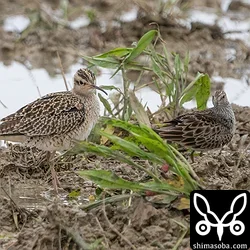
6th Ishigaki Island Snipe Camp side notes: a Broad-billed Sandpiper showed at close range, and the paddies also produced a flock of Sharp-tailed Sandpipers, Long-toed Stints in summer plumage, freshly arrived Eurasian Whimbrels, breeding Greater Painted-snipes, and Cinnamon Bitterns in beautiful nuptial plumage.

While traveling between sites, we encountered Ruddy Kingfishers, a Crested Serpent Eagle, Red-throated Pipits, and a large flock of Eastern Yellow Wagtails.

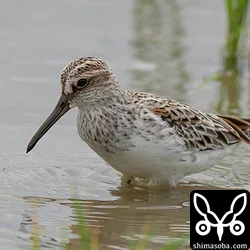
When I first spotted it the Broad-billed Sandpiper was at the far end of the rice paddy, but it gradually worked its way closer.

Third visit to Yonaguni this month

March 18, 2026

I made my third trip to Yonaguni Island this month. Small passerines were the main attraction: White Wagtail, Eastern Yellow Wagtail, Little Bunting, Daurian Redstart, and Brown Shrike among others.

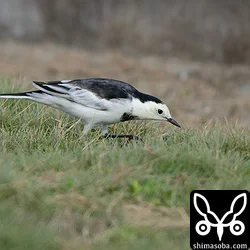
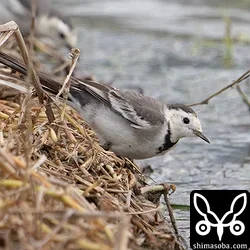
There was a mixed flock of three subspecies of White Wagtail. This is a male leucopsis.

Birdwatching on Yonaguni Island

March 4, 2026

I squeezed in some birdwatching alongside a work trip to Yonaguni Island. Strong winds and occasional rain kept migrant numbers low.

Even so, there was a spring feel to it: Common Hoopoe, a flock of several dozen male White Wagtails, a group of around 30 Red-throated Pipits, and large flocks of Eastern Yellow Wagtail.

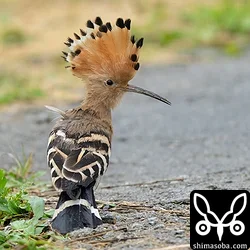
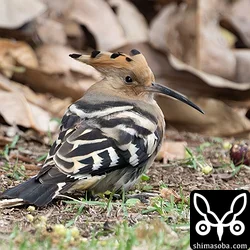
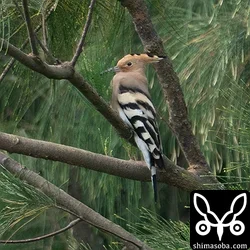
A Eurasian Hoopoe near the northern coast. It was foraging in light rain.

Last Birding of 2025 (video)

Dec. 31, 2025

December was hectic with repeated work trips and preparations for Omoto526, a single-unit rental guesthouse opening very soon, so I barely managed to get out birding at all.

Instead, a Crested Serpent Eagle, a Common Kestrel and Olive-backed Pipits have started turning up in our garden. A Black-winged Kite appears morning and evening.

I'd like to take things more slowly and do some proper birdwatching next year — though who knows how that will go… ^^;

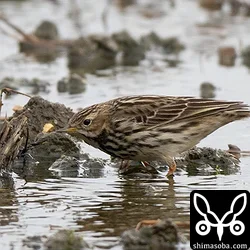
A Red-throated Pipit with a short tail. There were also several Citrine Wagtails in the same condition. Perhaps they were grabbed by the Eurasian Sparrowhawk that has been holding territory over this paddy.

Red-throated Pipit, Arctic Warbler, and Grey-faced Buzzard Migration

Oct. 15, 2025

I photographed Red-throated Pipit and Arctic Warbler for the first time this season. I had already confirmed both by sight and call a few days ago.

On this day, more than 8,500 Grey-faced Buzzards were counted — a record — but by the time I arrived during a break from work the peak had already passed and I ended up counting only around 200…

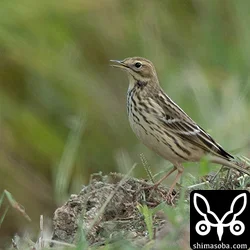
A small flock of about ten Red-throated Pipits arrived. One or two Buff-bellied Pipits appeared to be mixed in, but I couldn't get a photo.

White-shouldered Starling, Red Collared Dove, Chinese Pond Heron, and others

Feb. 3, 2025

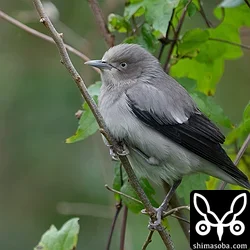
A quick stop at a rice paddy near the town centre turned up White-shouldered Starling, Red Collared Dove, Chinese Pond Heron, Red-throated Pipit, Eurasian Skylark, and Eastern Yellow Wagtail. Being able to fit in some birdwatching even in a short spare moment is one of the great things about Ishigaki Island. ^^

A female Daurian Starling appeared right in front of me.

Siberian Eastern Yellow Wagtail, Siberian Pipit, Red-throated Pipit

Jan. 16, 2025

Among a flock of several dozen Eastern Yellow Wagtails and Red-throated Pipits, there was one Siberian Eastern Yellow Wagtail. This season the numbers of Eastern Yellow Wagtails and Red-throated Pipits have been low — quite disappointing.

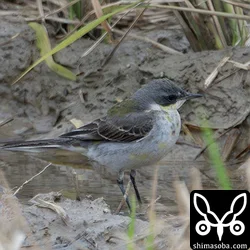
Eastern Yellow Wagtail (beema), first-winter plumage.

Malayan Night Heron, Chinese Pond Heron, Crested Serpent Eagle Juvenile

Jan. 10, 2025

While I was eating my packed lunch in the park, a juvenile Malayan Night Heron wandered up to me. It had not been fed by people — it just happened to approach. Even so, the lack of wariness in a juvenile Malayan Night Heron is worrying.

About three Chinese Pond Herons were wintering in the paddies. They seem to be foraging in a variety of habitats — dropping into drainage channels and disappearing into the grass.

I caught up for the first time in a while with "Hayate," the juvenile Crested Serpent Eagle released in November last year. It had moved more than 10 km south in a straight line from the release point. The area is close to town and has heavy traffic, so I worry it may be hit by a vehicle.

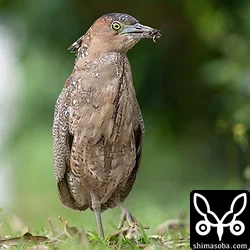
A juvenile Malayan Night Heron. Born last year, it is in the process of molting into adult plumage.

Upland Buzzard, Little Bunting, Black-tailed Gull and more on Yonaguni

Dec. 20, 2024

About five days on Yonaguni for work. Managed a little birdwatching in the spare time. Around Yonaguni Airport: two Upland Buzzards, an Eastern Buzzard, a Hen Harrier, a Peregrine Falcon and a Common Kestrel, apparently hunting small birds in the grass along the runway.

Pale Thrushes were present in large numbers across the island — flocks of thirty or more in the best spots. A few Brown-headed Thrushes were also seen. Pale Thrushes and Brown-headed Thrushes were concentrated mainly in the northern part of the island from Sonai to Kubura, while Dusky Thrushes were conspicuous in the south from Minamimakiba to Hikawa.

Little Buntings, Eastern Yellow Wagtails, Red-throated Pipits and Daurian Redstarts were all holding on through the strong winds. At Kubura fishing port, two Black-tailed Gulls and four Black-headed Gulls were staying over.

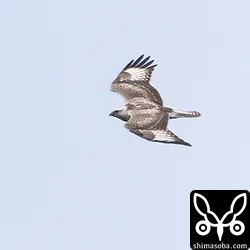
A juvenile Upland Buzzard appeared in the distance.

Common Hoopoe, Malayan Night Heron, Pacific Swift, Red-throated Pipit and more (video)

March 21, 2024

The second wave of Common Hoopoes seems to be winding down. Somewhere between 40 and 50 Common Hoopoes have arrived on Ishigaki this season. While searching for them I came across several Malayan Night Herons whose nuptial colouring has deepened noticeably.

Red-throated Pipit and Siberian Pipit numbers are fluctuating wildly — flocks seem to be passing through one after another. The season's first Pacific Swift and Temminck's Stint also appeared. Little Ringed Plovers are fully in summer plumage and moving through. There was a beautiful male Common Ringed Plover in summer plumage too, but I missed the shot… ^^;

For snipe it's all Common Snipe. The Pin-tailed Snipe I found on 20 February and the Swinhoe's Snipe on 21 February remain the only records, with nothing since.

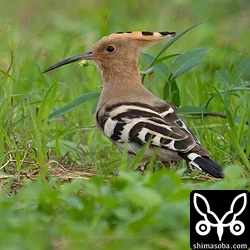
A Eurasian Hoopoe looking tired, apparently just arrived on migration.

Common Hoopoes every day, Chinese Blackbird still present, White Wagtails of the leucopsis subspecies everywhere

March 9, 2024

The Common Hoopoes on Ishigaki are rivalling the banner year of 2015 in numbers. In 2019, when I was posted to Okinawa main island, an exceptionally large influx of Common Hoopoes arrived as well. This year too, I'm guaranteed to encounter Common Hoopoes somewhere every single day. Every bird is remarkably tame and easy to watch. On this day they were confirmed across the southern, western and northern parts of Ishigaki.

Two Chinese Blackbirds are still present. These individuals are also quite unwary, making for relaxed photography. ^^ I've now found their feeding spot, so they should be even easier to see from here on.

I recorded Black-winged Kite in the northern part of Ishigaki for the first time. Breeding behaviour was first confirmed on the island in 2016, fledglings left the nest in 2017, and in the roughly seven years since, the species has spread across the entire island. There's a real possibility it could expand further to Miyako-jima and Okinawa main island in the future.

White Wagtails of the leucopsis subspecies are present in flocks of up to 50, and almost every White Wagtail I see anywhere on the island is of this subspecies — finding a nominate-type bird is the harder task. Good numbers of returning Red-throated Pipits are also arriving. Little Ringed Plovers are foraging alongside them.

I didn't bother photographing them, but White-shouldered Starling, Red-billed Starling, Common Starling and Eastern Yellow Wagtail are also around.

Five groups of birding acquaintances from the mainland are visiting the island this month — if things continue like this, they're in for a great trip. ^^

A Eurasian Hoopoe spotted in the grass. As usual, it was feeding on cockroaches.
Pin-tailed Snipe, Swinhoe's Snipe, Javan Pond Heron and more (video)

Feb. 22, 2024

After finding the season's first Pin-tailed Snipe the day before , I went back after work to try for shots of the tail feathers. You want the first record of the season to be done properly. While I was there I also picked up the season's first Swinhoe's Snipe — more than a month earlier than usual. Spring migration this year is behaving strangely.

Two Javan Pond Herons are continuing to winter here. Every year I hope they'll stay long enough to come into breeding plumage, but in most years they depart during February. We'll see how this season goes.

I'll be holding the "2nd Ishigaki Snipe Camp" sometime in early to mid-April. A report from the 1st is here → Day 1 , Day 2 , Extra edition .

First-winter Pin-tailed Snipe. Same individual as the previous day.

Olive-backed Pipit, White Wagtail, Red-throated Pipit, and Others

Feb. 10, 2024

Olive-backed Pipits have been wintering at several sites since last year, but they are hard to photograph. This day I found them by call — six birds had come down onto a lawn. Among the many small birds that dart around constantly, the Olive-backed Pipit's unhurried movements are a real pleasure to watch.

Nearby was a Dusky Thrush. This winter Dusky Thrushes, Pale Thrushes, and Brown-headed Thrushes have all been very scarce. Driving the forest roads I can hear them calling from the undergrowth, but almost none are coming out onto farmland. Some winters are full of Naumann's Thrushes, but there seems to be a year-to-year cycle driven by something or other.

In the rice paddies, flocks of several dozen Eastern Yellow Wagtails and Red-throated Pipits. Among a group of around fifteen White Wagtails there was also a leucopsis White Wagtail. This season leucopsis birds are scarce and ocularis birds are plentiful.

Temminck's Stints, Common Greenshanks, Wood Sandpipers, and Little Ringed Plovers are also present here and there.

A Tree Pipit I finally managed to photograph. There are several around my house, but they are so wary I haven't been able to get a shot.

Red Collared Dove, Lesser White-fronted Goose, Eurasian Sparrowhawk, Caspian Tern and more

Nov. 15, 2023

Lesser White-fronted Goose, Siberian Pipit, Northern Lapwing, Eurasian Sparrowhawk, and Caspian Tern all photographed for the first time this season in one go. Red Collared Doves continue to stay at multiple locations.

Common Snipe numbers are growing as birds settle into wintering mode. Dunlin, Green Sandpiper, Black-winged Stilt, Common Greenshank, Marsh Sandpiper, and Common Redshank are also wintering in the island's paddies, though in small numbers.

Among raptors, Crested Serpent Eagle is becoming easier to find, and Common Kestrel, Grey-faced Buzzard, Eastern Marsh Harrier, Hen Harrier, and Peregrine Falcon are all increasing.

Pale-capped Pigeon male juvenile. Spooked by raptors and not coming down into the paddies.

Red Collared Dove, Black-winged Kite, Crested Serpent Eagle and more

Nov. 1, 2023

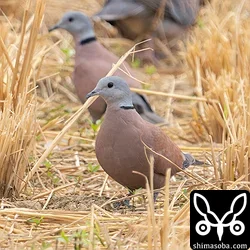
Red Collared Dove numbers have been slow to build this season, but several have finally come in — around six individuals confirmed so far.

Black-winged Kites have recently been appearing in groups: two adults and one juvenile. On this day two were careening over the paddy fields and scattering all the small birds.

Crested Serpent Eagle juveniles are down in number this year, but encounters with adults are gradually increasing. The calls carry clearly from my house as well.

Small birds are also visiting the farmland. Red-throated Pipit, Eastern Yellow Wagtail, and Brambling confirmed — the Brambling was my first photograph of the species this season.

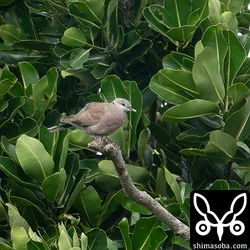
Two male Cream-coloured Doves. A female had also been present a few days earlier.

Little Curlew, Pectoral Sandpiper, and Pin-tailed Snipe!! (video)

April 15, 2023

After several consecutive clear days, bird numbers on Ishigaki had been dropping — but today's heavy rain brought in all sorts of things.

In the same area of paddies, Little Curlew, Pectoral Sandpiper, and Pin-tailed Snipe all turned up together. And a miracle: Little Curlew and Pectoral Sandpiper in the same frame!!

Little Whimbrel and White-rumped Sandpiper together. I don't think I'll ever get this combination in a single shot again!!

Common Hoopoe, Rosy Starling, Red-billed Starling, White's Thrush, and More (video)

March 21, 2023

Common Hoopoes are being reported from all over the island. It looks like a decent start to the season.

The Rosy Starling that has been wintering since last year is gradually moulting. I'm hoping it will stay as long as possible, but I have a feeling it may move on soon…

Lately, a fairly large flock of Red-billed Starlings has been coming to the car park at my workplace. They appear to be feeding on the fruits of the planted ironwood trees.

A completely fearless White's Thrush turned up — spotted and pointed out to me by a friend visiting from Akita Prefecture. I had several encounters with White's Thrush from late last year into early January, but after that they vanished. This individual seems to have stopped in on spring passage.

Japanese Bush Warblers have increased sharply, just as the Manchurian Bush Warblers have completely disappeared. I'm hearing subsong frequently these days. Little Buntings and Red-throated Pipits — whether they're on passage or moving around within the island I can't say — are fluctuating, with numbers going up and down.

Eurasian Hoopoes at the reliable spot. There appeared to be around four of them.

Little Bunting, Red-throated Pipit, Eastern Yellow Wagtail and others

Feb. 14, 2023

Little Buntings are wintering here, but they bury themselves in the grass and are hard to photograph. Their call notes can be heard everywhere.

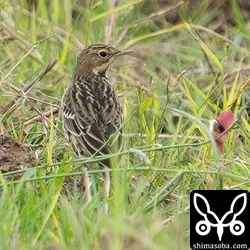
Red-throated Pipits also tend to stay hidden, but this flock came out into open ground and was easy to observe. The birds were in various stages of moult, which made for a good mix.

Wagtails included White Wagtail, Taiwanese White Wagtail, Eastern Yellow Wagtail and Grey Wagtail all together.

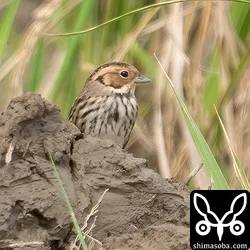
A fair number of Little Buntings are wintering in the rice paddies on the island, but they're difficult to photograph.