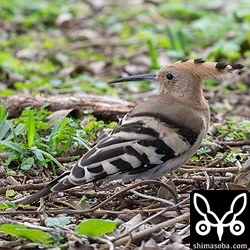
The second Common Hoopoe of the season has arrived. The Common Hoopoe is one of the birds that herald spring on Ishigaki Island, though it feels as if the arrival date gets a little earlier every year.
With the warmer weather, Crested Serpent Eagle and Black-winged Kite on Ishigaki Island have been observed carrying nesting material and displaying — confirmed breeding behaviour. Wintering waders and ducks are still present.
A Eurasian Hoopoe that turned up a little early. There are good years every few years, but I have a feeling this season will see a large influx of Eurasian Hoopoes on Ishigaki Island.
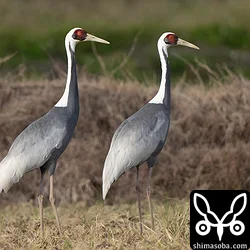
A White-naped Crane has arrived on Ishigaki for the first time in six years, since the first island record in 2020. It is a big, beautiful bird. A Siberian Crane has been wintering on Iriomote since last year — I would love to get over there to see it if the chance arises.
Crested Serpent Eagles are in the early stages of the breeding season; on fine days you can often hear a male and female calling back and forth.
Grey-faced Buzzards, Common Kestrels, Peregrine Falcons, Eastern Buzzards and Ospreys are all wintering on the island, but I have not seen an Upland Buzzard since I spotted one on Yonaguni in December last year — they seem scarce this season.
The first visit since October 2020. This time there were two adults. The Purple Heron looked no bigger than a Little Egret!!
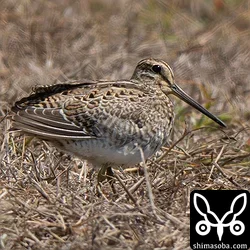
Pin-tailed Snipe have dropped sharply and the fields are now full of Common Snipe. A few Swinhoe's Snipe are still hanging on. Last year the final Pin-tailed Snipe of the autumn migration was recorded on 18 October. I wonder how long they'll be around this season. I don't think the 2024 birds will overwinter, but Pin-tailed Snipe and Swinhoe's Snipe were confirmed in February. I know it's getting ahead of myself, but I'd love to find overwintering birds in 2026.
I went back to check on the Grey-faced Buzzards again today after yesterday's visit, but things were quiet — it felt like the main push had already moved through the day before… ^^; At this time of year my daily snipe rounds make it hard to get out and watch the Chinese Sparrowhawk and Grey-faced Buzzard migration properly…
A juvenile Pin-tailed Snipe. This might turn out to be my last Pin-tailed Snipe of the season.
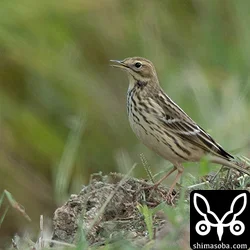
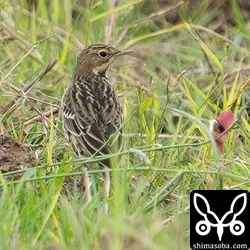
I photographed Red-throated Pipit and Arctic Warbler for the first time this season. I had already confirmed both by sight and call a few days ago.
On this day, more than 8,500 Grey-faced Buzzards were counted — a record — but by the time I arrived during a break from work the peak had already passed and I ended up counting only around 200…
A small flock of about ten Red-throated Pipits arrived. One or two Buff-bellied Pipits appeared to be mixed in, but I couldn't get a photo.
Crested Serpent Eagles are active early in the breeding season. On fine days you can see them displaying high overhead or hear them calling back and forth. The young birds have to keep a low profile so they don't get picked on by the agitated adults.
Overwintering Eastern Marsh Harriers and Grey-faced Buzzards are still present, but they should be heading north before long.
A juvenile Crested Serpent Eagle hatched last year. It has been holding territory in this area since around the end of the year. Sometimes chased off by adults, but it always comes back — a bold individual. ^^
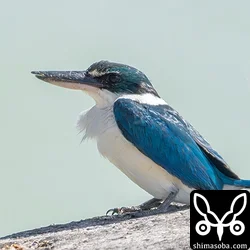
A friend was visiting Ishigaki Island, so I checked on the Collared Kingfisher. It was doing well at its usual stretch of coastline. There are some guys drinking there in the middle of the day, but the bird doesn't seem to mind much. It flushes when pedestrians approach, but quickly returns to its regular perch on the tetrapod or the windbreak branches.
I spotted the Black-winged Kite on the way back from the municipal office — it was perched on a phone line eating a mouse. The town birds have lost a lot of their wariness toward people and are easy to observe.
A Collared Kingfisher on a tetrapod. Perching on spots like this is probably why its tail feathers are so heavily worn.
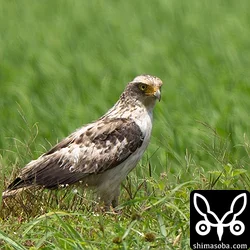
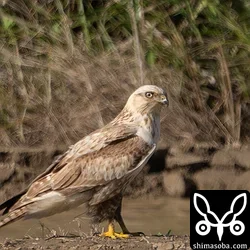
Two Upland Buzzards found within the space of an hour. Combined with the two from Yonaguni and two from Ishigaki, that makes four individuals confirmed this season. All are juveniles.
A juvenile Upland Buzzard perched at the top of a windbreak.
I went birding on the side of a work trip to Okinawa Main Island to cover the general election. The confirmed result for Okinawa District 4 came in just after 11 p.m. I quickly wrote and filed the article, returned to the hotel for a shower, then arrived in Yambaru just after 3 a.m.
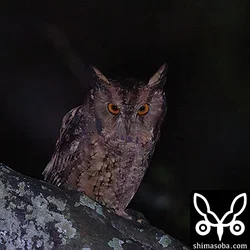
It was my first night search in Yambaru in nearly three years, but hitting two reliable spots I encountered three Ryukyu Scops Owls. I had forgotten my flash, so I managed to photograph them using the rental car's headlights and a handheld torch. Before 5 a.m. I caught a short nap in the car. On the way back I stopped at Kin and Awase Tidal Flats and saw Eurasian Curlew, Far Eastern Curlew, ducks, snipe and other waders.
I visited the usual spot where Ryukyu Scops Owls breed, and sure enough one was there. I was also able to hear the well-known descending call: "Wok, wok, wok, woh."
I couldn't get away for summer vacation because work was too busy, so we made a last-minute family trip to Miyako-jima. We visited the Grey-faced Buzzard migration survey site on Irabu-jima. The terrain is very flat, and the tsunami evacuation shelter at the survey point is only three stories tall — quite different from the mountaintop surveys on Ishigaki-jima. Birds that had headed out over the sea but given up heading south were coming back and dropping down onto Shimoji-jima one after another.
One of the surveyors told me that back when Grey-faced Buzzards were still hunted, crowds of people would show up at night with torches in the Casuarina forest along the channel between Irabu-jima and Shimoji-jima — from a distance it looked like some kind of festival. Of course, nobody hunts Grey-faced Buzzards anymore.
A small patch of scrubby woodland held plenty of Grey-streaked Flycatchers on migration. I also picked up two Blue-and-white Flycatchers. I heard Black Wood Pigeons calling and got fairly easy views by following the sound, but I was out walking with the kids so I never got to the point of raising the camera…
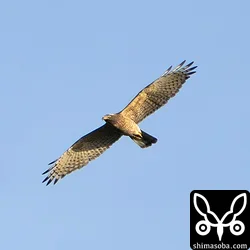
Grey-faced Buzzard photographed from farmland. Miyako-jima has no hills, so kettles of raptors could be watched from farmland and residential areas alike.
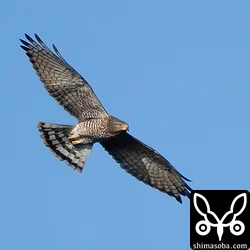
On Ishigaki Island, juvenile Black-winged Kites and Crested Serpent Eagles have been showing themselves and delighting birdwatchers. Common Kestrels, Grey-faced Buzzards, and Eurasian Sparrowhawks are wintering. Upland Buzzards, Peregrine Falcons, and Eastern Marsh Harriers are also present.
A Javan Pond Heron and a Chinese Pond Heron are wintering companionably in the same rice paddy. They have been here since last year and made it safely through the new year. A few breeding-plumage feathers are beginning to show.
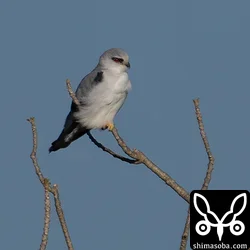
A Black-winged Kite observed at eye level at one of my regular spots. It's perching on its favourite branch as usual, eyes gleaming red.
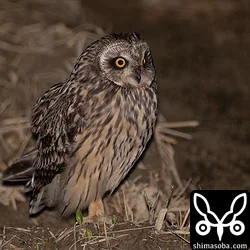
A Short-eared Owl has come to winter here again this season. Many other raptors are also wintering, including Upland Buzzard, Peregrine Falcon, Grey-faced Buzzard, Common Kestrel, and Hen Harrier.
Short-eared Owl in the rice fields. This individual doesn't mind people, so it's easy to watch — but I don't want to disturb its hunting, so I kept the record shots to under a minute.
The raptors that winter on Ishigaki Island are now all showing up: Upland Buzzard, Saker Falcon, Eastern Marsh Harrier, Grey-faced Buzzard, Common Kestrel, Short-eared Owl, and more.
The ducks, Eurasian Coots, and small birds that serve as prey are on edge whenever a raptor appears.
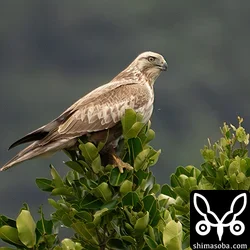
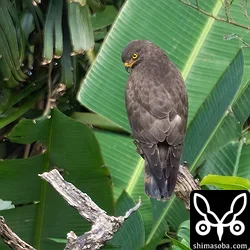
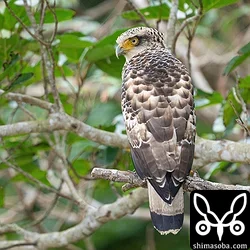
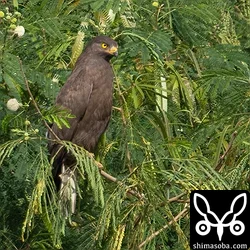
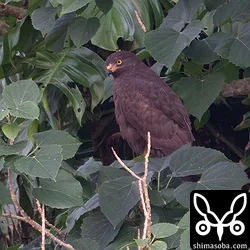
Juvenile Upland Buzzard. One appears every year, but this individual is not very wary and is easy to observe and photograph.
Grey-faced Buzzard migration is at its peak. On this day, more than 3,000 birds passed through — what I believe is an all-time record. I was on Kuroshima for work, so after returning to Ishigaki I rushed over to the usual migration watchpoint. Even on the way there, Grey-faced Buzzards were boiling up from all directions. Apparently there was also a kettle of more than 1,000 birds.
After I arrived, Grey-faced Buzzards continued to pour in from everywhere and form kettles. Among them I could pick out dark-morph individuals — the so-called black Grey-faced Buzzard.
A considerable number came down into the woodlands without completing the crossing, so tomorrow morning's roost departure should be spectacular.
Grey-faced Buzzard, adult male.
Thinking it would soon be departing on migration, I went to look at the dark-morph Grey-faced Buzzard for the first time in a while. It first arrived on Ishigaki Island as a juvenile in 2018, and has returned to the same rice field every year since — this is its fifth season. I hope it keeps coming back.
A Peregrine Falcon is wintering in the rice fields. Eurasian Coots and Eastern Cattle Egrets are being taken regularly.
The dark-morph Grey-faced Buzzard, returning for the fifth consecutive year since it was a juvenile.
Wishing everyone a happy new year.
The new year got off to a rough start — the entire family came down with COVID-19 right at the beginning of the holidays. We couldn't go anywhere, and I spent the time in bed until the 8th. ^^
My first birding of the year was on the 9th. Overwintering since last year: Common Crane, Ruddy Shelduck, Common Shelduck, Tundra Swan, Korean Kestrel, Grey-faced Buzzard, Eastern Marsh Harrier, Hen Harrier, thrushes, wagtails, Amur Stonechat, Chinese Pond Heron, and four species of starling.
For New Year's, you can't leave out a juvenile Crested Serpent Eagle — the bird celebrated in the Okinawan song "Washi nu Tui-bushi."
The dark-morph Grey-faced Buzzard that has been wintering on Ishigaki Island for five consecutive years has become easier to observe. It may be showing itself in prominent spots because it is facing off against a neighbouring individual in an adjacent territory.
Korean Kestrels are numerous this season, with three individuals confirmed. Continental birds must be bold — none of them shows any wariness at all.
A dark-morph Grey-faced Buzzard visiting for the fifth consecutive year. After a long while, I was finally able to photograph it in sunlight.
The dark-morph Grey-faced Buzzard that has been overwintering on Ishigaki Island every year since 2018 has returned again this year. It was a juvenile in the first year, so it is now 5 years old. It has been gradually becoming less wary, and this year I was able to observe it at quite close range.
The Black-winged Kite first appeared on Ishigaki Island in 2015 and has been breeding steadily ever since, to the point where it can now be seen all over the island — and it has finally moved into town as well. On this day I confirmed two birds flying together over the MaxValu in Maesato. I also frequently see them foraging on the wasteland to the east of Ishigaki City Hall.
A Black Baza wintering on Ishigaki Island. This marks its fifth year visiting. It typically stays until around March.