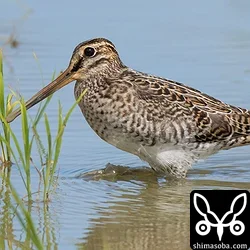
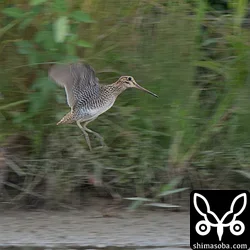
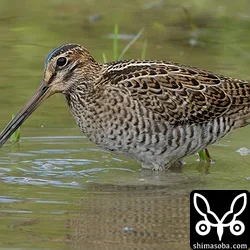
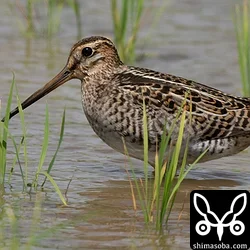
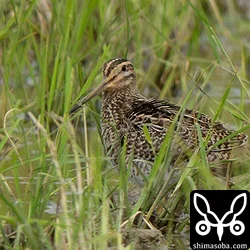
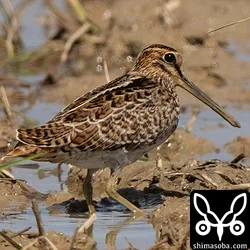
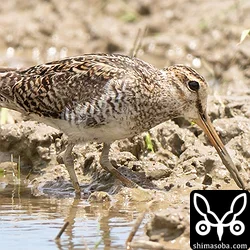
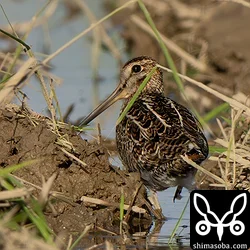
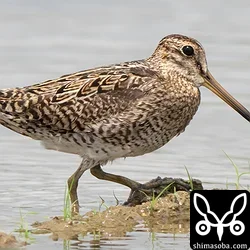
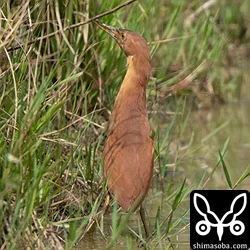
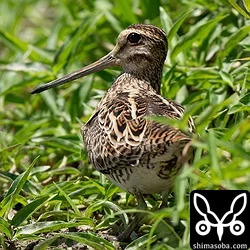
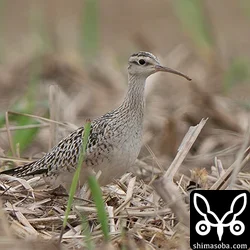
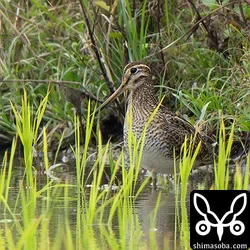
By mid-September the Pin-tailed Snipe numbers are falling and Swinhoe's Snipe are coming to dominate. After this, a second wave of Pin-tailed Snipe is expected.
Juvenile Red-necked Stints have started arriving. Long-toed Stint, Common Greenshank, Dunlin, and Superb Lyrebird are also present.
The only Pin-tailed Snipe of the day was at the far end of the paddy field — a long way off….
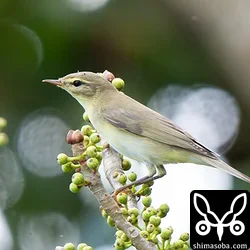
Birding in the gaps between work assignments on Yonaguni Island. As I cruised the forest road with a sense that autumn migration was well and truly getting under way, I spotted a fig tree that birds were gathering in. While watching a flock of Warbling White-eyes, a yellow warbler flew into my field of view. I got it in the binoculars — it was a Willow Warbler!! It was moving from branch to branch, apparently picking off small insects.
I also had first records for the trip of Chinese Sparrowhawk, Oriental Dollarbird, Dark-sided Flycatcher, Asian Brown Flycatcher, Grey-streaked Flycatcher, Garganey, Common Snipe, and White-shouldered Starling. Yonaguni Island delivers, as always. ^^
Arctic Warbler makes an appearance. It stands out clearly — obviously different from the other Japanese leaf warblers.
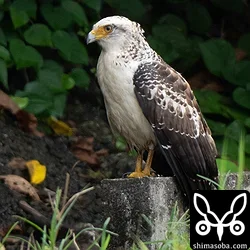
As the young birds begin to move away from their parents, juvenile Crested Serpent Eagles are becoming easier to observe. Multiple juveniles have been confirmed across Ishigaki Island. There were no typhoons this season so breeding success looks good — I'm looking forward to seeing how many individuals are counted.
Of the recent Greater Painted-snipe brood, one chick died in the nest, but the surviving chick is doing well with the parent. There are plenty of predators — cats, crows, and Black-winged Kites — so let's hope it makes it through safely.
Crested Serpent Eagle, juvenile. When it spotted something in a roadside ditch it would swoop down — practising its hunting on its own.
Juvenile Pin-tailed Snipes have finally arrived. Swinhoe's Snipe are also increasing in both adults and juveniles. For some reason, Pin-tailed Snipe are being recorded in unusually high numbers in the central part of the island this season as well. Most appear to be juveniles.
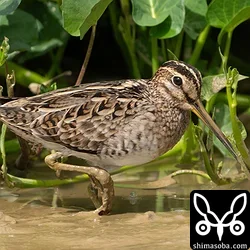
Juvenile Pin-tailed Snipe.
Pin-tailed Snipe and Swinhoe's Snipe have finally arrived on Ishigaki Island. Juveniles should start coming in from here, and numbers are expected to keep climbing toward the peak in late August to early September. Something to look forward to.
The 5th Ishigaki Island Snipe Camp currently has one person signed up. There is room for one or two more, so if you feel like enduring the ordeal, please get in touch. ^^ You are also welcome to browse the past Ishigaki Island Snipe Camp reports.
Found an adult Pin-tailed Snipe among three snipe. We pulled the car up close, waited until their wariness eased, then began watching.
Ishigaki Island is lively with a mix of winter visitors that have not yet headed north, passage migrants stopping over, and resident birds active as breeding season gets underway.
Most conspicuous lately are Cinnamon Bitterns in full breeding season — I am encountering them in rice paddies all over the place. Tufted Duck and Eurasian Coot are among those that should have gone north but are still here; most have departed, but a few individuals appear to remain. I have also recorded snipe on passage.
A male Ryukyu Minivet— I often see it flying about actively.
We held the 4th Ishigaki Island Snipe Camp again this year. Two participants came down from Hokkaido. That said, snipe numbers were already low during the pre-camp scouting the day before, and I had a bad feeling about it. Sure enough — poor results. It ended up being the worst outing yet: one Pin-tailed Snipe, a few Swinhoe's Snipe, and a few Common Snipe.
On the plus side, we managed to see around 50 species including Collared Kingfisher, Ryukyu Kingfisher, Crested Serpent Eagle, and various resident and migratory birds, which everyone was happy about, so I'll call it good. Years like this happen.
The only Pin-tailed Snipe of the day. A beautiful individual — I knew what it was the moment it came into the binoculars.
I did some birdwatching during free time on a work trip to Yonaguni Island.
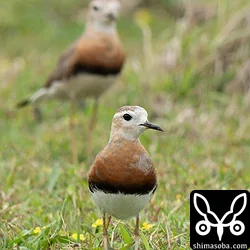
The timing was good — in a short while I was able to see Oriental Plover, Black Redstart, Citrine Wagtail, Common Hoopoe, Pin-tailed Snipe, and Swinhoe's Snipe. It was all thanks to the senior birders staying on the island!!
Seven Large Sand Plovers arrived early in the morning at the go-to spot on Yonaguni Island. I got the message while I was at work, so I was fidgeting.
Two consecutive days of bad weather brought large numbers of shorebirds and plovers — apparently mid-migration — dropping in to localized spots. The biggest group was Black-winged Stilts, over 400 birds, followed by Wood Sandpipers at 200+. There were too many to keep counting, so I stopped midway. ^^;
Pied Avocet, Black-tailed Godwit, Marsh Sandpiper, Curlew Sandpiper, Sharp-tailed Sandpiper, and Garganey also arrived, making the paddies extremely lively — though two days later everything was back to normal. ^^;
Along the coast, Greater Sand Plover numbers increased, and a small number of Grey Plovers also came through.
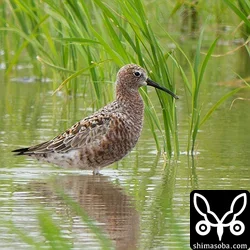
Two Curlew Sandpipers confirmed.
I managed to find a Pin-tailed Snipe that has moulted into winter plumage!! I picked it out from among 40 snipe together with Swinhoe's Snipe and Common Snipe. I had been searching with the belief that "there should still be Pin-tailed Snipe around," and the fact that the bird I finally found was an adult that had already finished moulting its scapulars and tertials into winter plumage made the moment even better!! A genuinely rare Pin-tailed Snipe in winter plumage.
Among the snipe still present, Swinhoe's Snipe numbered a few individuals; the rest were all Common Snipe.
Behold!! The splendid appearance of this adult Pin-tailed Snipe cloaked in winter plumage!!
Autumn is well and truly here — White-winged Terns, Garganey, Ruffs and Arctic Warblers are all building up steadily and the paddies are getting lively. Snipe numbers have also jumped sharply: 40 Common Snipe against 2 Swinhoe's Snipe. I couldn't find any Pin-tailed Snipe.
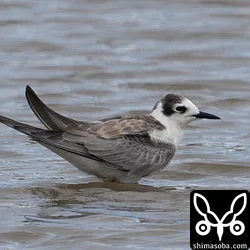
White-winged Tern, juvenile. The third bird this season.
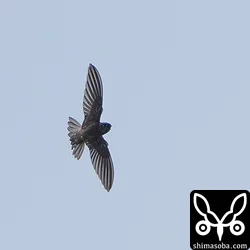
While I was watching Chinese Sparrowhawk migration, a Himalayan Swiftlet appeared!! Dark, slender and very sharp-looking.
Several hundred Chinese Sparrowhawks moved through. The largest single group was a few dozen birds. Migration should continue for a while, but I'm keeping an eye on the typhoon track.
I also had my first Eurasian Coots of the season and juvenile Pacific Golden Plovers. A flock of around 100 Ashy Minivets and the calls of Arctic Warblers were in the air too — it feels like autumn is deepening.
A Himalayan Swiftlet appeared. It was flying around together with swallows at high speed.