A daily record.
Featuring photos of wild birds and nature, mainly from Okinawa Main Island and Ishigaki Island

Four Common Hoopoes, possible Naumann's × Redwing hybrid, Red-billed Starling, Arctic Warbler and more (video)
March 15, 2024

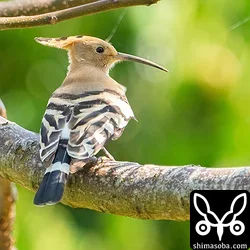
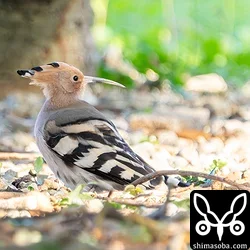
During a work break I counted four Common Hoopoes. Others were being seen elsewhere on the island — there were apparently at least seven birds present that day.

There was an odd thrush that looked like a Naumann's Thrush. The pattern on the breast and flanks wasn't quite right for Naumann's Thrush, and the bird gave an overall impression of Redwing. It seems quite likely to be a Naumann's Thrush × Redwing hybrid.

Eyebrowed Thrush, Brown-headed Thrush and Pale Thrush were all feeding on Machilus berries, but they disappeared into the branches and I couldn't get any photos.

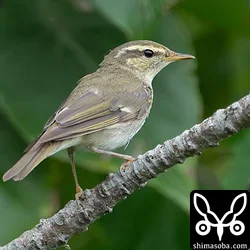
The Arctic Warblers that have been wintering on Ishigaki are thinning out as the weather warms — they appear to be moving steadily northward. The individual that had been wintering around my house has quietly vanished.

A Eurasian Hoopoe that has been staying for over a week. It's unusual for one to linger that long on spring passage.
Common Hoopoes every day, Chinese Blackbird still present, White Wagtails of the leucopsis subspecies everywhere

March 9, 2024

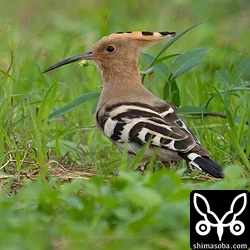
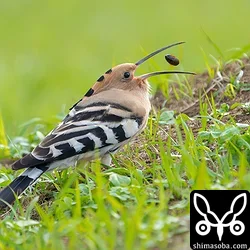
The Common Hoopoes on Ishigaki are rivalling the banner year of 2015 in numbers. In 2019, when I was posted to Okinawa main island, an exceptionally large influx of Common Hoopoes arrived as well. This year too, I'm guaranteed to encounter Common Hoopoes somewhere every single day. Every bird is remarkably tame and easy to watch. On this day they were confirmed across the southern, western and northern parts of Ishigaki.

Two Chinese Blackbirds are still present. These individuals are also quite unwary, making for relaxed photography. ^^ I've now found their feeding spot, so they should be even easier to see from here on.

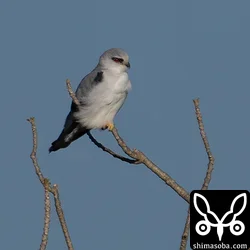
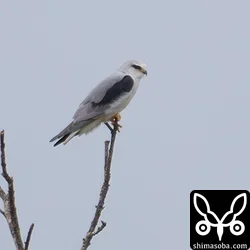
I recorded Black-winged Kite in the northern part of Ishigaki for the first time. Breeding behaviour was first confirmed on the island in 2016, fledglings left the nest in 2017, and in the roughly seven years since, the species has spread across the entire island. There's a real possibility it could expand further to Miyako-jima and Okinawa main island in the future.

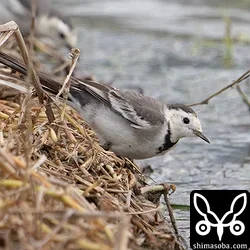
White Wagtails of the leucopsis subspecies are present in flocks of up to 50, and almost every White Wagtail I see anywhere on the island is of this subspecies — finding a nominate-type bird is the harder task. Good numbers of returning Red-throated Pipits are also arriving. Little Ringed Plovers are foraging alongside them.

I didn't bother photographing them, but White-shouldered Starling, Red-billed Starling, Common Starling and Eastern Yellow Wagtail are also around.

Five groups of birding acquaintances from the mainland are visiting the island this month — if things continue like this, they're in for a great trip. ^^

A Eurasian Hoopoe spotted in the grass. As usual, it was feeding on cockroaches.

More Common Hoopoes, and a first island record Snow Goose (video)

March 7, 2024

As on the previous day, Common Hoopoes were turning up all over the place — six birds at five sites over two days. I was only making brief detours while travelling for work, so there are likely quite a few more on the island than I've been finding.

I have no photos, but two Snow Geese appeared — a first record not just for Ishigaki but for all of Okinawa Prefecture. They were still being seen just before sunset, so I'm hoping they're still on the island. Getting a re-find and some photos is the goal. ^^

I also caught up with Dusky Thrush — numbers had been exceptionally low this season. Naumann's Thrush was noted at three sites, but the birds were either too wary, the conditions too poor, or I simply ran out of time during work, so I got no photos.

Daurian Redstarts on the move appear to be coming through, and I'm encountering them more frequently.

A Eurasian Hoopoe picks up a cockroach and flicks it straight into its bill. The usual way it eats.

Common Hoopoe and Chinese Blackbird arrive; Crested Serpent Eagle active

March 5, 2024

I was up in the northern part of Ishigaki for work, so I took the chance to do a bit of birding. I had a feeling Common Hoopoe and Chinese Blackbird might have arrived, so I made a short detour — and found them straight away. Two Common Hoopoes at two sites, and one Chinese Blackbird. Common Hoopoes are being seen in good numbers on Okinawa main island, Miyako-jima and Iriomote as well; this could be a bumper year.

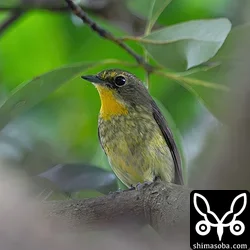
Also present were Arctic Warbler, Kamchatka Leaf Warbler, Daurian Redstart and Mugimaki Flycatcher. White Wagtail numbers are up, but almost all of them are the leucopsis subspecies — the largest flock was close to 30 birds. In a typical year the leucopsis birds arrive first, followed by the nominate subspecies a while later.

In the paddies, Crested Serpent Eagle — both juvenile and adult — and Malayan Night Heron are being encountered frequently.

Four Spotted Redshanks dropped out of the sky into a rice field. They came in from the direction of the sea, so they may be the birds that were recorded on Iriomote a few days ago.

Eurasian Hoopoe resting on a branch. It ended up settling in and staying put just like that.

Crested Serpent Eagle juvenile, Malayan Night Heron, Pin-tailed Snipe, Northern Lapwing and more

March 1, 2024

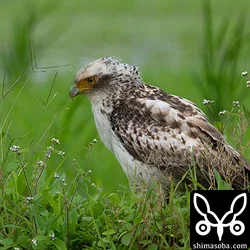
The one Crested Serpent Eagle juvenile that's been reliably viewable was at it again today — foraging at its own pace in the rice fields, walking the bunds and catching what looked like small insects.

Malayan Night Heron adults are turning up more often. This day I had three adults and one juvenile.

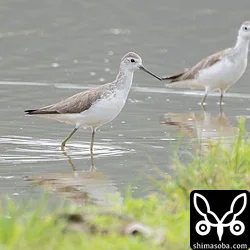
The Pin-tailed Snipe is still present. The same paddy field held nearly 30 Common Snipe — presumably spring migrants passing through. New arrivals of Common Redshank, Common Greenshank and Wood Sandpiper were also noted. Migration is picking up pace.

The season's first Northern Lapwing and Grey-headed Lapwing have also arrived.

A completely fearless Crested Serpent Eagle, juvenile.

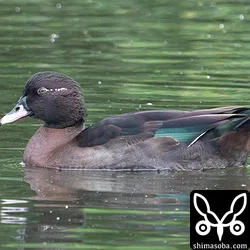
雑種ガモ

Feb. 28, 2024

A hybrid duck. I have no idea what's going on… ^^;

Arctic Warbler and three snipe species (video)

Feb. 24, 2024

Arctic Warbler numbers are lower than in the bumper year two years ago, but a reasonable number are still wintering here. Lately I've also been hearing Kamchatka Leaf Warbler calls — possibly birds already on the move.

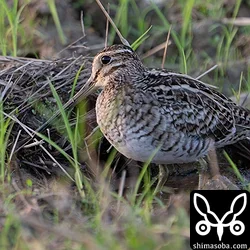
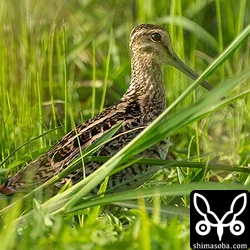
For snipe, all three species have shown up earlier than usual: Pin-tailed Snipe, Swinhoe's Snipe and Common Snipe together at the same time.

An overwintering Lesser Whitethroat appeared right in front of me. I've confirmed the ID by call, but I also think I can make out the classic Lesser Whitethroat feature of P10 being shorter than the primary coverts. ^^;

Pin-tailed Snipe, Swinhoe's Snipe, Javan Pond Heron and more (video)

Feb. 22, 2024

After finding the season's first Pin-tailed Snipe the day before , I went back after work to try for shots of the tail feathers. You want the first record of the season to be done properly. While I was there I also picked up the season's first Swinhoe's Snipe — more than a month earlier than usual. Spring migration this year is behaving strangely.

Two Javan Pond Herons are continuing to winter here. Every year I hope they'll stay long enough to come into breeding plumage, but in most years they depart during February. We'll see how this season goes.

I'll be holding the "2nd Ishigaki Snipe Camp" sometime in early to mid-April. A report from the 1st is here → Day 1 , Day 2 , Extra edition .

First-winter Pin-tailed Snipe. Same individual as the previous day.

First Pin-tailed Snipe of the Season

Feb. 21, 2024

I recorded the first Pin-tailed Snipe of the season. In a normal year they don't arrive until April, so this is more than a month early. This season a Ruddy Kingfisher had already reached Ishigaki Island as well, and I get the impression the seasons are running ahead of schedule.

Update, 22 February

It is a typical Pin-tailed Snipe, but since it was the first of the season I went back the next day just to be safe and photographed the tail feathers. That settles it with a certificate of authenticity. ^^

The first Pin-tailed Snipe of the season. An easy-to-read individual. It did not move at all from the grass, then when a Black-winged Kite appeared it hid completely in the undergrowth.

Active Ryukyu Flycatchers, Crested Serpent Eagle, and a Long-Absent Black Kite

Feb. 20, 2024

Warm days have continued, and I can now hear Ryukyu Flycatchers singing as I drive the forest roads. Common Emerald Doves are calling too. I also confirmed a Ruddy Kingfisher calling from my house — earlier than usual, possibly due to the mild winter.

Crested Serpent Eagles are in the early stages of the breeding season; wherever I go — rice paddies, sugarcane fields, forest roads — I find them in pairs.

Eastern Yellow Wagtails look set to finish the season without ever reaching their peak wintering numbers. Could this also be a mild-winter effect, with fewer flocks moving south from the continent?

Ryukyu Flycatcher heading into second-summer plumage.

Olive-backed Pipit, White Wagtail, Red-throated Pipit, and Others

Feb. 10, 2024

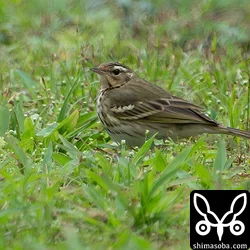
Olive-backed Pipits have been wintering at several sites since last year, but they are hard to photograph. This day I found them by call — six birds had come down onto a lawn. Among the many small birds that dart around constantly, the Olive-backed Pipit's unhurried movements are a real pleasure to watch.

Nearby was a Dusky Thrush. This winter Dusky Thrushes, Pale Thrushes, and Brown-headed Thrushes have all been very scarce. Driving the forest roads I can hear them calling from the undergrowth, but almost none are coming out onto farmland. Some winters are full of Naumann's Thrushes, but there seems to be a year-to-year cycle driven by something or other.

In the rice paddies, flocks of several dozen Eastern Yellow Wagtails and Red-throated Pipits. Among a group of around fifteen White Wagtails there was also a leucopsis White Wagtail. This season leucopsis birds are scarce and ocularis birds are plentiful.

Temminck's Stints, Common Greenshanks, Wood Sandpipers, and Little Ringed Plovers are also present here and there.

A Tree Pipit I finally managed to photograph. There are several around my house, but they are so wary I haven't been able to get a shot.

Black-winged Kite Fledgling, Crested Serpent Eagle Juvenile, Javan Pond Heron, Chinese Pond Heron, and Others

Feb. 7, 2024

On Ishigaki Island, juvenile Black-winged Kites and Crested Serpent Eagles have been showing themselves and delighting birdwatchers. Common Kestrels, Grey-faced Buzzards, and Eurasian Sparrowhawks are wintering. Upland Buzzards, Peregrine Falcons, and Eastern Marsh Harriers are also present.

A Javan Pond Heron and a Chinese Pond Heron are wintering companionably in the same rice paddy. They have been here since last year and made it safely through the new year. A few breeding-plumage feathers are beginning to show.

A Black-winged Kite observed at eye level at one of my regular spots. It's perching on its favourite branch as usual, eyes gleaming red.

Black-winged Kite, Upland Buzzard, Crested Serpent Eagle Juvenile, Peregrine Falcons, and More (with Video)

Jan. 31, 2024

This season Ishigaki Island has a rich variety of raptors, including wintering birds. Upland Buzzards: three birds at two locations on the island. Peregrine Falcons: juveniles, subadults, and adults all seem to be present in unusually high numbers. Common Kestrels are everywhere.

The Black-winged Kites are approaching the end of the breeding season, and the juvenile Crested Serpent Eagles become more active in their foraging as the weather warms.

Black-winged Kite in the middle of breeding. The chicks will fledge soon.

Wintering Waders

Jan. 30, 2024

Shorebirds are wintering along the coast and in the rice paddies. The most numerous are Greater Sand Plovers, Siberian Sand Plovers, and Ruddy Turnstones on the coast. Unusually for Ishigaki Island, a flock of Grey Plovers is also wintering.

Shorebird numbers in the paddies this season are low; species present include Common Greenshank, Marsh Sandpiper, Common Snipe, Wood Sandpiper, and Green Sandpiper.

Little Stint, winter plumage.

Geese and Ducks All Present

Jan. 25, 2024

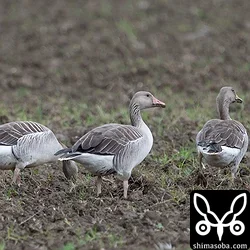
The wintering ducks of Ishigaki Island are all assembled. Six Greylag Geese, Taiga Bean Geese, and Greater Bean Geese have arrived; in the rice paddies the most numerous ducks are Eastern Spot-billed Ducks, Northern Shovelers, and Eurasian Wigeons, while a large flock of Tufted Ducks is on the reservoir. Mallards, Eurasian Teals, Northern Pintails, Gadwalls, and Falcated Ducks are also present. This season I am seeing Mallard × Eastern Spot-billed Duck hybrids frequently.

Update, 3 March 2024

The six Greylag Geese that were on Ishigaki Island until around the end of January were on Kume Island as of late February. I hear a Smew is also there; since the Greylag Geese on Ishigaki sometimes used the same reservoir as a Smew, that bird too may have moved from Ishigaki.

The Grey-lag Geese have been here since last year — a long stay. All five are present.

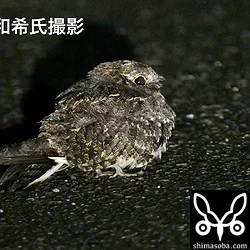
First Japanese Record — Savanna Nightjar!!

Jan. 16, 2024

Friends on Okinawa's main island contacted me to say a Savanna Nightjar had turned up, so I made a quick dash to see it. I finished covering my company's relay-race event at full speed, jumped on the last ANA flight, and landed at Naha Airport. Takeshita-kun, who had first spotted the Savanna Nightjar, came to meet me, and together with a young businessman just back from Europe we rushed to the site in Yomitan.

Takeshita-kun and a crowd of other Okinawa acquaintances had gathered, and the Savanna Nightjar was found almost as soon as the search began. Congratulating myself as usual on my good bird luck, I thought, "this is easy" — and the three of us took a relaxed attitude, figuring we had plenty of time until the first flight out in the morning and could take a good long look after everyone else had gone home.

Then came the moment to get serious. I took over driving from the jet-lagged young businessman and made circuits of the farmland at the spot. We were overconfident, and time just slipped by without any sign of the bird. Before I knew it, it was 6 a.m. — time to head for the airport. Incredibly, after those first two brief views, the bird never reappeared, and the whirlwind trip was over.

Unfortunately I got no photographs this time, but I did manage to see its compact, charming little shape. ^^

Seeing the location in person, I think there is every chance of finding one in the Yaeyamas too. I hope to track one down on Ishigaki Island before long. ^^

Large-tailed Nightjar — a first record for Japan!! I wasn't able to get a photo myself, so Takeshita-kun kindly provided one!!

Short-eared Owl, Crested Serpent Eagle, Grey-faced Buzzard

Jan. 9, 2024

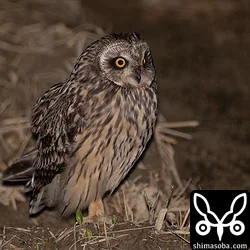
A Short-eared Owl has come to winter here again this season. Many other raptors are also wintering, including Upland Buzzard, Peregrine Falcon, Grey-faced Buzzard, Common Kestrel, and Hen Harrier.

Short-eared Owl in the rice fields. This individual doesn't mind people, so it's easy to watch — but I don't want to disturb its hunting, so I kept the record shots to under a minute.

Caspian Tern, Common Gull and others (video)

Jan. 9, 2024

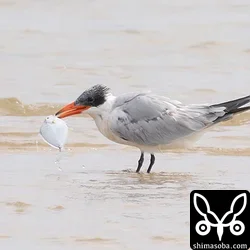
A Caspian Tern was wrestling with a large fish on the coast. The fish was deep-bodied and the tern seemed to have real trouble swallowing it. The thread-like dorsal fin visible in the footage suggests it was a Silvery Moony.

Greater Crested Terns swallow small fish on the wing, but this Monocle Bream was too large, so the bird carried it to the water's edge. Looking closely, I could see it tearing off the obstructive dorsal and pectoral fins with its bill.

An All-White Light-vented Bulbul

Jan. 6, 2024

I thought a remarkably white bird had just flown past — and it turned out to be an almost entirely white Light-vented Bulbul. I wondered at first whether it was an albino, but looking at the photos there seems to be a little pigment remaining. Initially I wasn't sure — Light-vented Bulbul? Japanese Bush Warbler? Wagtail? — but the call, "ji-biru, ji-biru," settled it as a Light-vented Bulbul.

While I was photographing it, about ten other Light-vented Bulbuls quickly joined in. They were feeding on the ripe berries of Japanese beautyberry and schefflera.

A beautiful leucistic Chinese Bulbul.