A daily record.
Featuring photos of wild birds and nature, mainly from Okinawa Main Island and Ishigaki Island

Citrine Wagtail, Common Shelduck, Black-tailed Godwit and more

Dec. 13, 2024
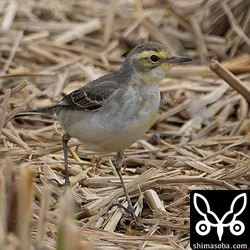
Two Citrine Wagtails were mixed in with a large flock of Eastern Yellow Wagtails feeding in a harvested rice paddy. The difference in character makes them stand out clearly even to the naked eye.

In flooded paddies, Black-tailed Godwits, Eurasian Whimbrels, Common Redshanks, Green Sandpipers, Common Shelducks and Eurasian Coots are wintering. Eurasian Coot numbers have been increasing. They have become a main prey item for the Upland Buzzard and Peregrine Falcon.

Citrine Wagtail, first-winter.
Pied Avocet, Crested Serpent Eagle and more

Dec. 13, 2024

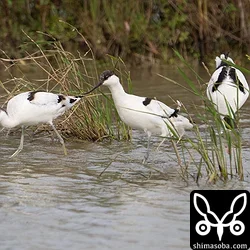
Three Pied Avocets have been staying for several days. Single birds have also been found elsewhere, so they may have dispersed from the flock of eleven that arrived in November.

The first Black-tailed Godwit of the season has turned up. Also wintering in the paddies: Common Greenshanks, Common Sandpipers, Green Sandpipers, Dunlins, Common Snipes, Black-winged Stilts, Common Redshanks and Wood Sandpipers.

Three Pied Avocets delighting visitors to the island.

Crested Serpent Eagle release

Dec. 6, 2024

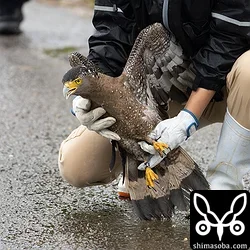
A Crested Serpent Eagle that was rescued after a traffic accident on 21 October has been successfully released. It is an individual that has been continuously monitored with a territory around Uradabaru for about ten years — a female affectionately known as "Point" for a mark on her right eye. Breeding has also been confirmed for the past several years.

At the time of rescue, a black leg ring engraved with "6" was fitted for individual identification. If you spot her, please let me know and I will report it to the relevant authorities.

Poised and clearly ready to fly.

Collared Kingfisher, Chinese Pond Heron, Malayan Night Heron and more (video)

Nov. 30, 2024

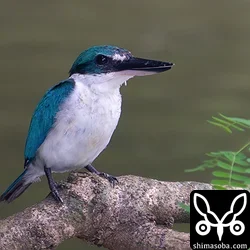
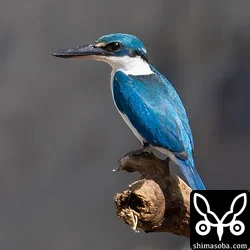
It has been over a month since the Collared Kingfisher appeared on Ishigaki. Its daily routine has become predictable, so the encounter rate is staying at nearly 100%. It has become more wary, though, so the key is to observe without letting the Collared Kingfisher notice you.

The Tundra Swan that was on Iriomote has moved over to Ishigaki. Conversely, the Oriental Stork that was on Ishigaki has crossed over to Iriomote.

In the woodland, a Narcissus Flycatcher was found. Arctic Warblers, Japanese Bush Warblers and Manchurian Bush Warblers are also wintering.

The long-staying Collared Kingfisher. When the sun hits it, it flashes brilliantly and the contrast intensifies.

Baillon's Crake, Oriental Stork, Pied Avocet, Black-faced Spoonbill, juvenile Crested Serpent Eagle and more

Nov. 26, 2024

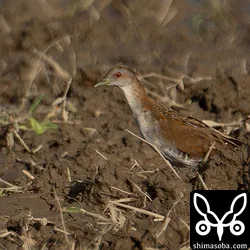
While watching the Oriental Stork, a Black Bittern flew into view, so I searched for where it had landed — and a Baillon's Crake appeared. ^^; It was a wary individual that ducked straight into the grass at the slightest disturbance. The habitat looks good, so it might stick around.

The Oriental Stork was a ringed individual. ID number "J0701", apparently hatched on 31 March this year in Obama City, Fukui Prefecture. It had also been observed in Minamisatsuma City, Kagoshima Prefecture, a week earlier. It stayed on Ishigaki for several days before crossing to Iriomote.

Two Pied Avocets are still present. Whether they are part of the flock of eleven that arrived on 6 November is unknown.

Encounters with juvenile Crested Serpent Eagles have been increasing. On this day I found the previously recorded "No. 7" and a new individual. With the second-crop rice harvest now underway, it is becoming a good season to watch Crested Serpent Eagles. This season's sugarcane harvest is scheduled to start around 6 December.

First Gadwall and Eastern White Wagtail of the season confirmed.

Adult White-browed Crake. It seemed quite wary.

Crested Serpent Eagle release and Bandit White-browed Crake

Nov. 24, 2024

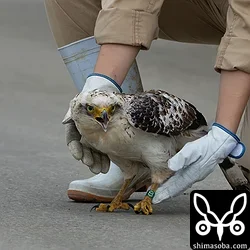
A juvenile Crested Serpent Eagle rescued on 28 October has been released. With no fractures or other serious injuries, it was returned to the wild in under a month. Ishigaki is a small island — please drive at a safe speed.

A juvenile Crested Serpent Eagle found by a local resident after being concussed in a traffic accident, and named "Hayate."

Collared Kingfisher's long stay — Caspian Tern, Red Collared Dove, Chinese Pond Heron

Nov. 24, 2024

The Collared Kingfisher on Ishigaki has been staying a long time. Its daily routine is settled, and it really feels like it will see the new year in. Caspian Terns and Black-headed Gulls are also visiting the beach where the Collared Kingfisher is found.

In nearby rice paddies, the first Taiga Bean Geese of the season were confirmed — a flock of six. Chinese Pond Herons, Red Collared Doves and Common Starlings are also present. It is all right on the doorstep, so there is plenty to enjoy there during the times when the Collared Kingfisher is not showing.

A Collared Kingfisher resting at its high-tide roost. Shot from behind cover because of the close distance.

Collared Kingfisher — Three Weeks and Counting

Nov. 13, 2024

Has it decided to winter here? The Collared Kingfisher is now into its third week of stay.

It appeared as if timing the moments when no one was around, then struggled to swallow a large crab whole. When a bicycle passed, it flew off somewhere with the crab still in its bill.

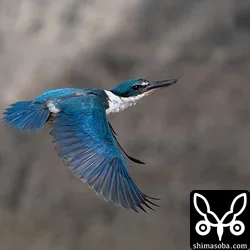
A Collared Kingfisher in flight, showing its beautiful wings.

Chestnut-winged Cuckoo and Pale Buzzard Show Up!!

Nov. 11, 2024

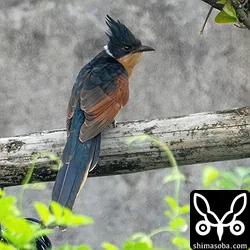
I had a work trip to Yonaguni Island after a long absence, so I went birding in my spare time. I came across a Chestnut-winged Cuckoo — found it at a private house in Sonai. It looked annoyed at being pestered by a Brown-eared Bulbul. I also spotted what appeared to be a Pale Buzzard.

Across the island, Emberizas were coming in in good numbers — Rustic Bunting, Yellow Bunting, Little Bunting and others. Narcissus Flycatcher, Daurian Redstart and Grey-streaked Flycatcher were staying all over the island. One Common Pochard had dropped into Kubura Mitou.

A juvenile Coral-billed Ground Cuckoo. It seemed to be using the drainage channel running behind some houses, but was chased off by a Brown-eared Bulbul and flew away somewhere.

Black Drongo and 11 Pied Avocets Arrive!! (video)

Nov. 7, 2024

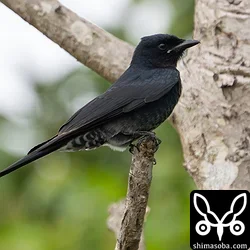
Ishigaki Island is getting strong northerly winds from unseasonably late Typhoon No. 22. I was out searching for the Black Bittern that had been reported the day before and the day before that, thinking "I wonder what else might turn up," when a message came in: "There's a Black Drongo here." I headed over and found a poorly-wary juvenile Black Drongo. It appeared to be preying on dragonflies and the like.

Toward evening, several acquaintances contacted me to say there was a flock of Pied Avocets. I was nearby on my way home from buying groceries at the supermarket, so I stopped in — and there was a flock of 11 Pied Avocets. In 2020 a flock of 7 visited Yonaguni Island, but this was well beyond that. The larger the flock, the more beautiful and impressive a sight it makes.

A Black Drongo perched on a branch right in front of me.

Black-winged Kite Hunting (video)

Nov. 6, 2024

I usually pass on Black-winged Kites when I see them, but this one was zeroing in on prey so I photographed it for the first time in a while.

I spotted an adult Black-winged Kite on a power line, repeatedly eyeing the grassland below. It moved from its first perch to a lower telephone wire, then changed orientation and plunged down. A few seconds later it burst out of the grass with a Black Rat already squeezed dead in its talons.

It brought the rat back to the telephone wire and began eating, all the while pumping its tail up and down and calling. I thought a female nearby might be coming to steal the prey, but the bird flew off to the east. Tracking it with the camera, I could see another Black-winged Kite arrive and snatch the rat away. Enlarging the photos, it looked as though the prey was being passed not to a female but to a juvenile.

On Ishigaki Island, Black-winged Kites breed year-round except in the depths of winter. They raise young roughly twice per season, so the population has grown considerably — on busy days you can count around 10 birds in a single day.

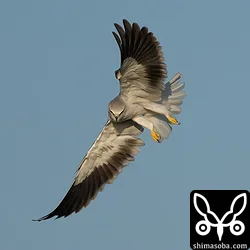
A Black-winged Kite locking onto prey.

Black-faced Spoonbill, Garganey, Northern Lapwing and Others

Nov. 6, 2024

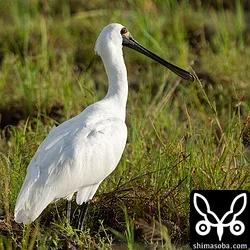
Two Black-faced Spoonbills are roaming and staying around the island. As it gradually starts to feel like autumn, Garganey, Eurasian Teal, Northern Shoveler, Eurasian Wigeon and Northern Pintail are also increasing.

Adult Black-faced Spoonbill.

Ryukyu Scops Owl on Okinawa Main Island

Oct. 29, 2024

I went birding on the side of a work trip to Okinawa Main Island to cover the general election. The confirmed result for Okinawa District 4 came in just after 11 p.m. I quickly wrote and filed the article, returned to the hotel for a shower, then arrived in Yambaru just after 3 a.m.

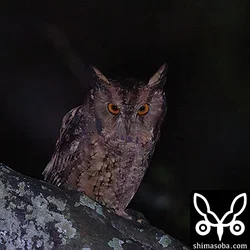
It was my first night search in Yambaru in nearly three years, but hitting two reliable spots I encountered three Ryukyu Scops Owls. I had forgotten my flash, so I managed to photograph them using the rental car's headlights and a handheld torch. Before 5 a.m. I caught a short nap in the car. On the way back I stopped at Kin and Awase Tidal Flats and saw Eurasian Curlew, Far Eastern Curlew, ducks, snipe and other waders.

I visited the usual spot where Ryukyu Scops Owls breed, and sure enough one was there. I was also able to hear the well-known descending call: "Wok, wok, wok, woh."

Collared Kingfisher Appears on Ishigaki Island!!

Oct. 25, 2024

A Collared Kingfisher has turned up on Ishigaki Island. There was previously a Collared Kingfisher that stayed at Manko on Okinawa Main Island from August 2017 through April 2018.

I was posted to the Naha bureau at the time, so I saw more than enough of that bird — but it is good to see one close to home. This individual seems more vivid in colour than the Okinawa Main Island bird.

The Collared Kingfisher is said to have 50 subspecies, and this one also appears to be Todiramphus chloris collaris. This year a Collared Kingfisher was also photographed by a friend on Miyako Island, and what looked like one was reported on another island in the Yaeyamas. This may be a bumper year for Collared Kingfishers. There is a good chance more will turn up elsewhere.

An adult Collared Kingfisher with a beautiful vivid-blue back. It appears to be in late summer plumage, so if it stays for a while I may get to see it in winter plumage.

Extremely Rare Adult Pin-tailed Snipe in Winter Plumage!! Swinhoe's Snipe, Common Snipe (video)

Oct. 19, 2024

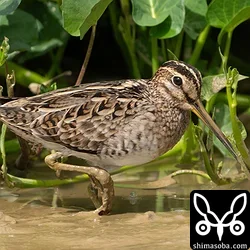
I managed to find a Pin-tailed Snipe that has moulted into winter plumage!! I picked it out from among 40 snipe together with Swinhoe's Snipe and Common Snipe. I had been searching with the belief that "there should still be Pin-tailed Snipe around," and the fact that the bird I finally found was an adult that had already finished moulting its scapulars and tertials into winter plumage made the moment even better!! A genuinely rare Pin-tailed Snipe in winter plumage.

Among the snipe still present, Swinhoe's Snipe numbered a few individuals; the rest were all Common Snipe.

Behold!! The splendid appearance of this adult Pin-tailed Snipe cloaked in winter plumage!!

First Mandarin Duck of the Season

Oct. 17, 2024

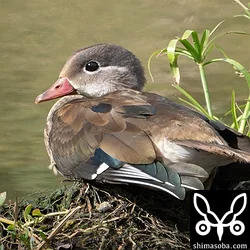
The first Mandarin Duck of the season has arrived. It was a male in eclipse plumage.

Male Mandarin Duck. It's in eclipse plumage, so it doesn't look very Mandarin-like.

Japanese Leaf Warbler — Close Encounter!!

Oct. 16, 2024

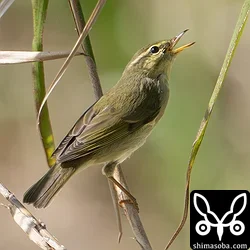
The Phylloscopus complex that can be found on Ishigaki Island consists of Arctic Warbler, Kamchatka Leaf Warbler and Japanese Leaf Warbler, but the great majority are Arctic Warbler.

I do get to see Japanese Leaf Warbler occasionally, and this time I was lucky enough to get close and photograph one — a rare treat!! I was also able to hear it call, and managed to get more than 10 shots. There are differences in body colour too.

For what it is worth, Kamchatka Leaf Warbler is so scarce that finding even one individual per season is uncertain. I would like to get it on video and in photos someday.

A very close encounter with a Kamchatka Leaf Warbler. An unusually unwary individual.

Family Trip to Miyako-jima

Oct. 14, 2024

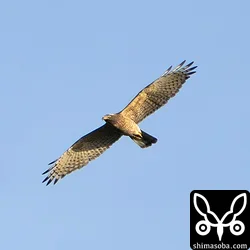
I couldn't get away for summer vacation because work was too busy, so we made a last-minute family trip to Miyako-jima. We visited the Grey-faced Buzzard migration survey site on Irabu-jima. The terrain is very flat, and the tsunami evacuation shelter at the survey point is only three stories tall — quite different from the mountaintop surveys on Ishigaki-jima. Birds that had headed out over the sea but given up heading south were coming back and dropping down onto Shimoji-jima one after another.

One of the surveyors told me that back when Grey-faced Buzzards were still hunted, crowds of people would show up at night with torches in the Casuarina forest along the channel between Irabu-jima and Shimoji-jima — from a distance it looked like some kind of festival. Of course, nobody hunts Grey-faced Buzzards anymore.

A small patch of scrubby woodland held plenty of Grey-streaked Flycatchers on migration. I also picked up two Blue-and-white Flycatchers. I heard Black Wood Pigeons calling and got fairly easy views by following the sound, but I was out walking with the kids so I never got to the point of raising the camera…

Grey-faced Buzzard photographed from farmland. Miyako-jima has no hills, so kettles of raptors could be watched from farmland and residential areas alike.

Ten Garganey Arrive; First White Wagtail of the Season

Oct. 12, 2024

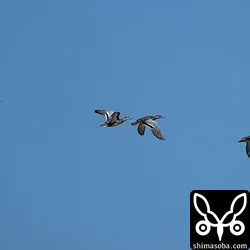
A flock of ten Garganey arrived, a mix of adults and juveniles.

First White Wagtail (leucopsis) of the season. On Ishigaki-jima the leucopsis type typically arrives first, followed by alba and ocularis at around the same time. Eastern Yellow Wagtail numbers keep fluctuating. The wintering birds should build up a bit more yet.

Whiskered Tern passage birds are increasing. From around late October the proportion of juveniles starts to rise. Black-winged Stilts can be seen in groups of around 20 birds at various locations, presumably on the move.

Male Garganey. All in eclipse.

White-winged Tern, Garganey, Arctic Warbler, Ruff Arrive

Oct. 5, 2024

Autumn is well and truly here — White-winged Terns, Garganey, Ruffs and Arctic Warblers are all building up steadily and the paddies are getting lively. Snipe numbers have also jumped sharply: 40 Common Snipe against 2 Swinhoe's Snipe. I couldn't find any Pin-tailed Snipe.

White-winged Tern, juvenile. The third bird this season.