A daily record.
Featuring photos of wild birds and nature, mainly from Okinawa Main Island and Ishigaki Island

Baillon's Crake, Oriental Stork, Pied Avocet, Black-faced Spoonbill, juvenile Crested Serpent Eagle and more
Nov. 26, 2024

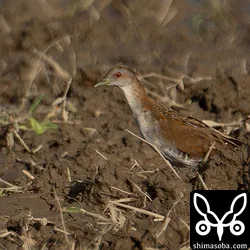
While watching the Oriental Stork, a Black Bittern flew into view, so I searched for where it had landed — and a Baillon's Crake appeared. ^^; It was a wary individual that ducked straight into the grass at the slightest disturbance. The habitat looks good, so it might stick around.

The Oriental Stork was a ringed individual. ID number "J0701", apparently hatched on 31 March this year in Obama City, Fukui Prefecture. It had also been observed in Minamisatsuma City, Kagoshima Prefecture, a week earlier. It stayed on Ishigaki for several days before crossing to Iriomote.

Two Pied Avocets are still present. Whether they are part of the flock of eleven that arrived on 6 November is unknown.

Encounters with juvenile Crested Serpent Eagles have been increasing. On this day I found the previously recorded "No. 7" and a new individual. With the second-crop rice harvest now underway, it is becoming a good season to watch Crested Serpent Eagles. This season's sugarcane harvest is scheduled to start around 6 December.

First Gadwall and Eastern White Wagtail of the season confirmed.

Adult White-browed Crake. It seemed quite wary.
Black-faced Spoonbill, Garganey, Northern Lapwing and Others

Nov. 6, 2024

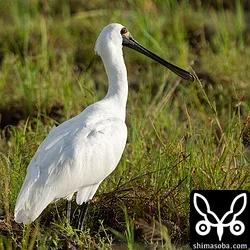
Two Black-faced Spoonbills are roaming and staying around the island. As it gradually starts to feel like autumn, Garganey, Eurasian Teal, Northern Shoveler, Eurasian Wigeon and Northern Pintail are also increasing.

Adult Black-faced Spoonbill.

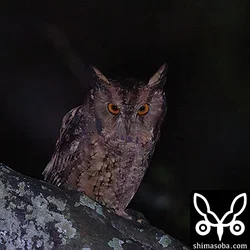
Ryukyu Scops Owl on Okinawa Main Island

Oct. 29, 2024

I went birding on the side of a work trip to Okinawa Main Island to cover the general election. The confirmed result for Okinawa District 4 came in just after 11 p.m. I quickly wrote and filed the article, returned to the hotel for a shower, then arrived in Yambaru just after 3 a.m.

It was my first night search in Yambaru in nearly three years, but hitting two reliable spots I encountered three Ryukyu Scops Owls. I had forgotten my flash, so I managed to photograph them using the rental car's headlights and a handheld torch. Before 5 a.m. I caught a short nap in the car. On the way back I stopped at Kin and Awase Tidal Flats and saw Eurasian Curlew, Far Eastern Curlew, ducks, snipe and other waders.

I visited the usual spot where Ryukyu Scops Owls breed, and sure enough one was there. I was also able to hear the well-known descending call: "Wok, wok, wok, woh."

Ten Garganey Arrive; First White Wagtail of the Season

Oct. 12, 2024

A flock of ten Garganey arrived, a mix of adults and juveniles.

First White Wagtail (leucopsis) of the season. On Ishigaki-jima the leucopsis type typically arrives first, followed by alba and ocularis at around the same time. Eastern Yellow Wagtail numbers keep fluctuating. The wintering birds should build up a bit more yet.

Whiskered Tern passage birds are increasing. From around late October the proportion of juveniles starts to rise. Black-winged Stilts can be seen in groups of around 20 birds at various locations, presumably on the move.

Male Garganey. All in eclipse.

White-winged Tern, Garganey, Arctic Warbler, Ruff Arrive

Oct. 5, 2024

Autumn is well and truly here — White-winged Terns, Garganey, Ruffs and Arctic Warblers are all building up steadily and the paddies are getting lively. Snipe numbers have also jumped sharply: 40 Common Snipe against 2 Swinhoe's Snipe. I couldn't find any Pin-tailed Snipe.

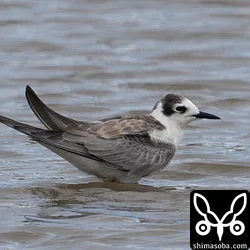
White-winged Tern, juvenile. The third bird this season.

Chinese Sparrowhawk Migration Begins; First Eurasian Teal

Sept. 26, 2024

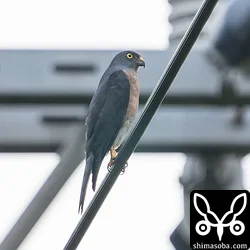
Chinese Sparrowhawk migration is under way. The weather has been unsettled but it should pick up in earnest from here. Two Eurasian Teal — my first of the season — had arrived.

Chinese Sparrowhawk, adult female.

Marsh Sandpiper, Common Greenshank, Common Redshank, and Others

Aug. 23, 2024

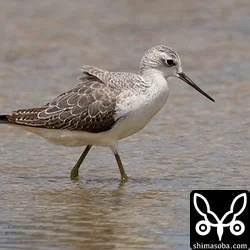
First record of a juvenile Marsh Sandpiper this season. Common Greenshank, Common Redshank, Black-winged Stilt, Wood Sandpiper, Long-toed Stint, and Red-necked Stint all appear to be passing through Ishigaki in a steady stream, with the cast turning over continuously.

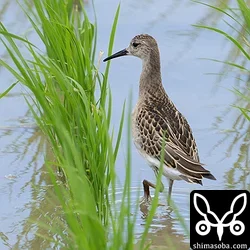
The first Marsh Sandpiper juvenile of the season. Already in first-winter plumage.

Waders increase after the typhoon passes

July 28, 2024

Typhoon No. 3 passed through without causing major damage, but even after it reached the western side of Taiwan the wind continued to make itself felt in the Yaeyamas.

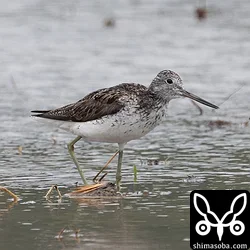
In the rice paddies, wader numbers increased considerably — Wood Sandpipers were present in flocks of several dozen wherever I went. Common Greenshank, Common Sandpiper, Green Sandpiper, Red-necked Stint, and Long-toed Stint were all up in numbers too, making for a lively scene.

A Common Greenshank still largely in summer plumage.

First Black-tailed Godwit, Sharp-tailed Sandpiper and Common Greenshank of the Season

April 20, 2024

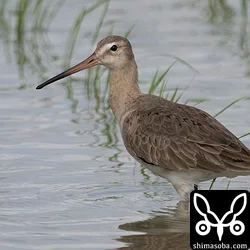
First records this season of Black-tailed Godwit, Sharp-tailed Sandpiper and Striated Heron. Unless the weather turns rough, large waders like the Black-tailed Godwit don't come down to Ishigaki. Striated Heron is scarce on the island, so finding one felt like a bonus.

The Black-tailed Godwit is still very much in winter plumage.

Kentish Plover, Whiskered Tern, Eurasian Spoonbill and Others

April 2, 2024

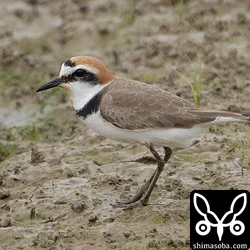
A Kentish Plover turned up that looks slightly different from the birds that breed on Ishigaki. I haven't paid much serious attention to Kentish Plovers before, but this individual stood out.

First Whiskered Terns of the season confirmed — two birds quartering over the rice paddies. A juvenile Eurasian Spoonbill is also still present; it's an individual with a noticeably pale bill. Wood Sandpiper and Black-winged Stilt numbers are up, though the peak for waders in the paddies hasn't really arrived yet this season. Little Ringed Plover and Long-toed Stint are also gradually increasing.

Isabeline Shrikes are thinning out as they head to breeding grounds. The pair of overwintering Peregrine Falcons is still here. The one-eyed Crested Serpent Eagle near my home is somehow hanging on. Ishigaki Tit appears to be busy with nesting.

Male Kentish Plover in breeding plumage. Beautiful. The breeding population in Okinawa is considerably paler.

Red Collared Dove, Lesser White-fronted Goose, Eurasian Sparrowhawk, Caspian Tern and more

Nov. 15, 2023

Lesser White-fronted Goose, Siberian Pipit, Northern Lapwing, Eurasian Sparrowhawk, and Caspian Tern all photographed for the first time this season in one go. Red Collared Doves continue to stay at multiple locations.

Common Snipe numbers are growing as birds settle into wintering mode. Dunlin, Green Sandpiper, Black-winged Stilt, Common Greenshank, Marsh Sandpiper, and Common Redshank are also wintering in the island's paddies, though in small numbers.

Among raptors, Crested Serpent Eagle is becoming easier to find, and Common Kestrel, Grey-faced Buzzard, Eastern Marsh Harrier, Hen Harrier, and Peregrine Falcon are all increasing.

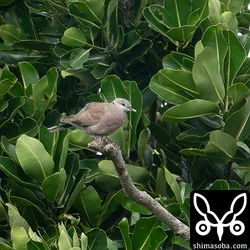
Pale-capped Pigeon male juvenile. Spooked by raptors and not coming down into the paddies.

Ruff, Marsh Sandpiper, Common Redshank, and more

Oct. 6, 2023

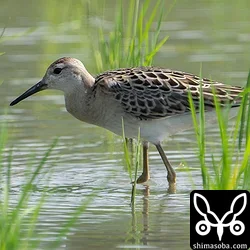
Ruff have turned up at several sites, almost all juveniles. The regulars — Red-necked Stint, Common Greenshank, Marsh Sandpiper, Common Redshank, and Long-toed Stint — are present in paddies everywhere. Dunlin have started to appear as well.

The first Pacific Golden Plovers of the season arrived in small flocks of juveniles. Around the park and cattle sheds, Chestnut-cheeked Starling, Red-billed Starling, and White-shouldered Starling are also increasing.

A juvenile Ruff.

1st Ishigaki Snipe Camp — Sideshow

Sept. 2, 2023

In this sideshow from the 1st Ishigaki Snipe Camp, I introduce the birds encountered during two days of snipe hunting.

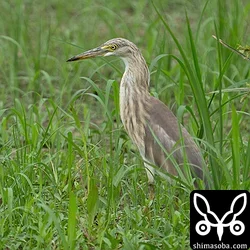
A Javan Pond Heron was found — the fourth individual on Ishigaki this season. First juvenile Common Greenshank, Green Sandpiper, and Red-necked Stint of the season were confirmed. An adult Sharp-tailed Sandpiper was seen for the first time this season. A Greater Painted-snipe family with small chicks was encountered.

Please also see the day 1 and day 2 reports.

A Javan Pond-Heron that stayed for several days.

Latest Spring Record for Pin-tailed Snipe

May 30, 2023

I found a Pin-tailed Snipe that is the latest spring migration record I've had. In just three more months the autumn migration of Pin-tailed Snipe will be starting… With Typhoon No. 2 approaching Ishigaki, there's a good chance it will stay into June. Something to look forward to.

Shorebird migration is nearly over, but a small group of Black-winged Stilts and Common Greenshanks has arrived.

An out-of-season Pin-tailed Snipe. Almost fully in summer plumage.

Paddy-field waders, Cinnamon Bittern, Eastern Yellow Wagtail, White-breasted Waterhen

May 5, 2023

The rice fields are lively with migrants, though the spring shorebird passage feels like it may be winding down. In good weather, birds seem to be turning over every two or three days.

Pin-tailed Snipe, Swinhoe's Snipe, Little Stint, and Broad-billed Sandpiper — all popular birds — are still present.

A Pin-tailed Snipe foraging along a paddy bund, mixed in with several Swinhoe's Snipe.

Little Curlew, Pectoral Sandpiper, and Pin-tailed Snipe!! (video)

April 15, 2023

After several consecutive clear days, bird numbers on Ishigaki had been dropping — but today's heavy rain brought in all sorts of things.

In the same area of paddies, Little Curlew, Pectoral Sandpiper, and Pin-tailed Snipe all turned up together. And a miracle: Little Curlew and Pectoral Sandpiper in the same frame!!

Little Whimbrel and White-rumped Sandpiper together. I don't think I'll ever get this combination in a single shot again!!

Pheasant-tailed Jacana — day 6; Lesser White-fronted Goose — day 10

Oct. 18, 2022

The Pheasant-tailed Jacana found on 12 October is still present, six days on. A tractor came through to work the field but the bird seemed largely unbothered and kept foraging.

The two Lesser White-fronted Geese are also still here — today is day ten. They continue to associate with the Taiga Bean Goose as before. Twelve Greater White-fronted Geese also arrived and briefly joined the group, but they eventually parted ways and are keeping to themselves.

Juvenile Pheasant-tailed Jacana. It showed no fear of the tractor and was snatching prey turned up by the fieldwork.