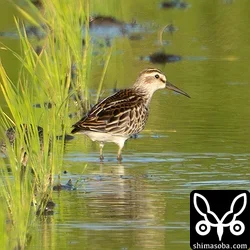
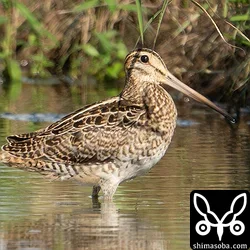
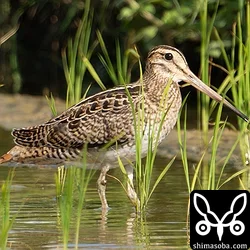
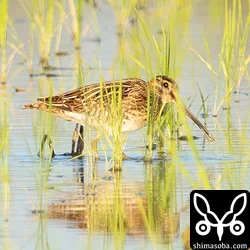
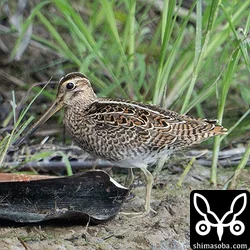
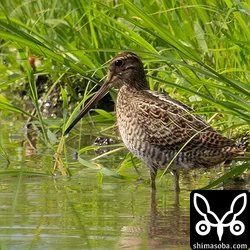
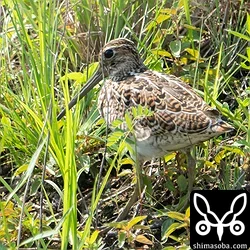
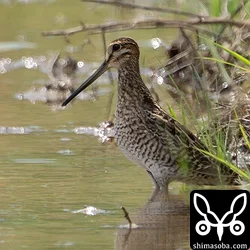
The large Swinhoe's Snipe I found yesterday — I caught up with it again. I also managed to photograph the tail feathers. I had been hoping for something a little more irregular, but it was unmistakably Swinhoe's Snipe, which was reassuring. ^^
A Swinhoe's Snipe with an impressive build.
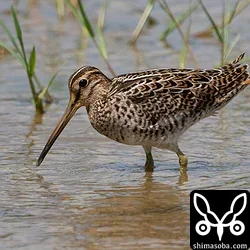
Among a flock of around 20 Swinhoe's Snipe, one individual stood out conspicuously. It was large-bodied with a long bill, reminiscent of a Latham's Snipe. At this time of year a bird in near-juvenile plumage cannot realistically be Latham's Snipe, so Swinhoe's Snipe it must be. The tertial pattern also does not fit Latham's Snipe.
A Swinhoe's Snipe juvenile that stood out quite a bit among the flock.
We held the 3rd Ishigaki Island Snipe Camp, which has earned quite a following. The participant came from Aichi Prefecture. As it happens, every participant from the 1st through the 3rd camps has been from Aichi. ^^;
This time an unavoidable work commitment cut things short, so we only had about three hours of snipe watching — but we spent that time poring over roughly 20 snipe in paddy fields in a single area with intense focus.
Individual numbers this season have been as high as usual, but Pin-tailed Snipe were frustratingly scarce. On the other hand, we got to observe some very interesting Swinhoe's Snipe, so as snipe camps go it was a great success. ^^
Swinhoe's Snipe, juvenile.
I went out to scout for the 3rd Ishigaki Island Snipe Camp. That said, these are rice paddies I check every day, so I already have a fair idea of who's around.
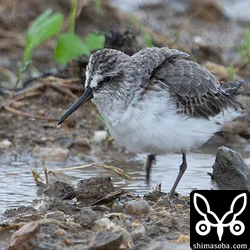
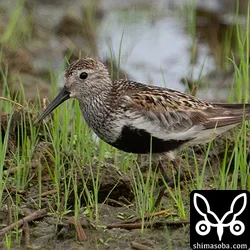
First records for the season: juvenile Broad-billed Sandpiper, Red-necked Stint, and Dunlin. All three are season firsts as juveniles.
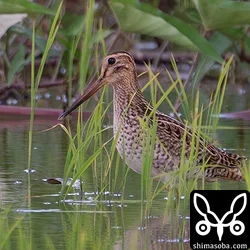
Swinhoe's Snipe, juvenile. A dark individual — or rather, one with a strong brownish tone. Every now and then you get a Swinhoe's Snipe like this.
There was a Pin-tailed Snipe in the finest condition I've seen this season. Among the Swinhoe's Snipe, one individual had notably narrow outer tail feathers — an interesting bird.
The juvenile Broad-billed Sandpiper is a first for the season.
Pin-tailed Snipe, juvenile. A very beautiful bird — I wanted to see it in full, but it was extremely wary and didn't move at all.
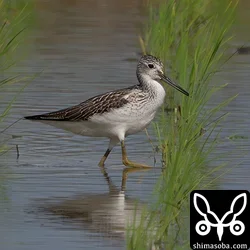
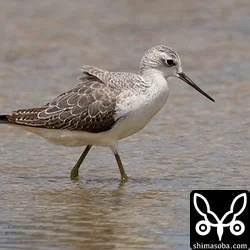
First record of a juvenile Common Greenshank this season. The remaining juvenile species still coming through include Red-necked Stint, Long-toed Stint, Dunlin, and Broad-billed Sandpiper.
Snipe are moving through steadily too. There are 20 or more in one area alone. The group seems to have settled into a regular cast, and things will probably stay that way until the second wave arrives.
Common Greenshank, juvenile. Still in full juvenile plumage.
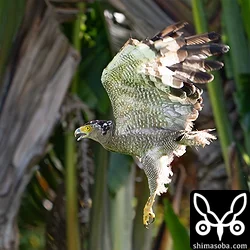
A Crested Serpent Eagle that was rescued after a traffic accident on June 20th was returned to the wild after 70 days. Its weight had plateaued at 680 grams, but it was in good spirits and flew off strongly the moment it was released. The tail feathers had fallen out, which seemed likely to affect its flight somewhat, but it should adapt in time.
A yellow identification band was fitted to the right leg for tracking purposes, and it was assigned the number "4". It is an adult male, and was named Kanki (神起) by the person who rescued it.
A Crested Serpent Eagle released into the wild, beating its wings powerfully. A band is visible on the right leg.
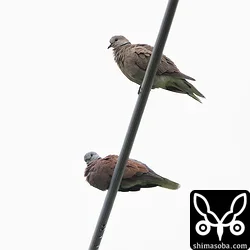
Red Collared Doves turned up at two locations, four birds in total. Grey Wagtail is also a first for the season. From here on, migrants with a distinctly autumnal feel will keep arriving on Ishigaki one after another.
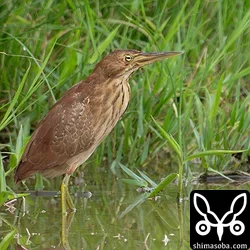
Painted Snipe were at two locations — two males and two females. In this paddy it was one male and two females.
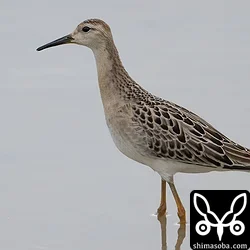
First record of a juvenile Marsh Sandpiper this season. Common Greenshank, Common Redshank, Black-winged Stilt, Wood Sandpiper, Long-toed Stint, and Red-necked Stint all appear to be passing through Ishigaki in a steady stream, with the cast turning over continuously.
The first Marsh Sandpiper juvenile of the season. Already in first-winter plumage.
Ishigaki had a rough day under the influence of a tropical depression. When the rain eased I did the rounds of the paddies and found the first Broad-billed Sandpiper of the season had arrived — encountered in a puddle in a sugarcane field. Out on the grassland I also picked up first records of Curlew Sandpiper and Grey Plover. Bad weather does have a way of pushing birds into unexpected places.
Found a Broad-billed Sandpiper in a puddle in a sugarcane field. Was able to observe it right in front of me.
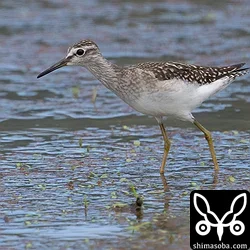
First juveniles of the season confirmed for Wood Sandpiper and Common Sandpiper. Red-necked Stint and Sharp-tailed Sandpiper also first records of the season. The Greater Painted-snipe chicks are still moving with the adults but have grown large enough that they are barely distinguishable from them.
First Wood Sandpiper juveniles of the season. It seems they arrived all at once.